This Monday (today) is St. Andrew's Day. Which can be a big deal in Scotland. And I had a ticket to "A St. Andrew's Day Party" at the Glasgow Royal Concert Hall. Phil Cunningham and Aly Bain were playing with the Royal Scottish National Orchestra.
Phil Cunningham is one of the best accordion players in the world, and Any Bain is one of the best fiddlers. He was a founder of Boys of the Lough. There were guests such as the 15 times world champion House of Egdar Shotts and Dykehead Pipe Band. It should have been an amazing concert. It was pretty good, but fell far short of what it could have been.
The problem was twofold. (1) These amazing songs had been arranged for a full orchestra, but that is not how they should be played. Orchestrised folk music always sounds very fake to me. It also sounded many many many times like they were playing Copeland. I would have sworn they were if they hadn't introduced the pieces beforehand. I don't dislike Copeland, but it was odd and distracting. (2) It was the wrong venue for folk music. This is a beautiful concert hall, great acoustics (except when the sound guys messed up, which was often, and also distracting), but I was so far removed from the performer, and thus from the music, that it hardly carried me at all. Folk music needs to be personal, needs to be close.
About a week ago, I was in City Centre one night, not far from where the Concert Hall is. These two guys were playing really amazing fiddle and guitar. Some of the best I'd ever heard. I even bought their CD. That is how folk music is best: simple and close. You can listen to them on their myspace.
Monday, 30 November 2009
Thanksgiving!
This Friday I hosted . . . THANKSGIVING!
Why Friday, you ask? Well, here in the UK, we don't get Thanksgiving Break, so I figured it would be easier for people to come if it were on Friday. Also that would give me both Thursday and Friday to cook, because I have only one lecture each of those days.
I did pretty much the whole thing: turkey, dressing, gravy, corn pudding, green bean casserole, sweet potatoes, mashed potatoes, biscuits, and pie! I'm pretty proud of myself. The only things I didn't do were cranberry sauce (Bryan bought some - we couldn't find cranberries to do it ourselves) and the pie crust. Oh, and the gravy was a little wonky. Very flavourful, almost like a ju, but very thin. Pumpkins are wicked expensive, so it was a butter-nut squash pie, but still amazing. And you can't find creamed corn here, so I had to make that myself too.
There were eight people. I had hoped for more but oh well. Oriane, Bryan, Jess, Ing Wan, Pablo, Guille, Irma, and me. Good times were had. And it turns out corn pudding is a tradition in Jess's family too, only they have it with cheese and call it Swiss corn bake.
I still have half a squash and tons of sweet and mashed potatoes left (along with some other odds and ins). I'll have to figure out what to do with them. The turkey carcass is being boiled for stock as we speak. No, we didn't finish a whole turkey, it was just the breast.
Why Friday, you ask? Well, here in the UK, we don't get Thanksgiving Break, so I figured it would be easier for people to come if it were on Friday. Also that would give me both Thursday and Friday to cook, because I have only one lecture each of those days.
I did pretty much the whole thing: turkey, dressing, gravy, corn pudding, green bean casserole, sweet potatoes, mashed potatoes, biscuits, and pie! I'm pretty proud of myself. The only things I didn't do were cranberry sauce (Bryan bought some - we couldn't find cranberries to do it ourselves) and the pie crust. Oh, and the gravy was a little wonky. Very flavourful, almost like a ju, but very thin. Pumpkins are wicked expensive, so it was a butter-nut squash pie, but still amazing. And you can't find creamed corn here, so I had to make that myself too.
There were eight people. I had hoped for more but oh well. Oriane, Bryan, Jess, Ing Wan, Pablo, Guille, Irma, and me. Good times were had. And it turns out corn pudding is a tradition in Jess's family too, only they have it with cheese and call it Swiss corn bake.
I still have half a squash and tons of sweet and mashed potatoes left (along with some other odds and ins). I'll have to figure out what to do with them. The turkey carcass is being boiled for stock as we speak. No, we didn't finish a whole turkey, it was just the breast.
A Couple Random Thoughts
Besides family, friends, all that crap (just kidding), I think what I miss the most from the US is apple cider. The non-alcoholic kind. Fresh pressed from the farm up the road, cold or mulled, and made into dough-nuts. Mmmmmmm. They don't have that here. They have hard cider, which is also amazing, and every bar has at least one on draught, but it's quite different.
Bryan, his girlfriend who was visiting, and I went to this place called the Polo Lounge on Wednesday. (I wasn't gonna be a third wheel, but Charlie chickened out.) It's a gay bar in City Centre that on Wednesdays has free entry and £1 drinks. All drinks. Well, almost. A RedBull and vodka was more, and doubles would be more. But even a pint of cider was a pound, and they're always at least £3.50. Also, it was brilliant. I don't like clubs, I don't like the music, I don't like the atmosphere, I don't like the crowd. Except this place. This place was brilliant. Friendly people (not too friendly either), fun music loud enough to rock out to but not so loud it melts your brain, fun dancing. The right price. I hear this is the norm at gay bars. I wonder why that is.
Bryan, his girlfriend who was visiting, and I went to this place called the Polo Lounge on Wednesday. (I wasn't gonna be a third wheel, but Charlie chickened out.) It's a gay bar in City Centre that on Wednesdays has free entry and £1 drinks. All drinks. Well, almost. A RedBull and vodka was more, and doubles would be more. But even a pint of cider was a pound, and they're always at least £3.50. Also, it was brilliant. I don't like clubs, I don't like the music, I don't like the atmosphere, I don't like the crowd. Except this place. This place was brilliant. Friendly people (not too friendly either), fun music loud enough to rock out to but not so loud it melts your brain, fun dancing. The right price. I hear this is the norm at gay bars. I wonder why that is.
Rosslyn Chapel and the Borders
Last weekend (I'm a week behind - gotta try to catch up) I went on an Arcadia trip to Rosslyn Chapel and the Borders. Wonderful trip.
Our first stop after departing from Edinburgh was Rosslyn Chapel. Rosslyn is considered by many to have the finest architecture in all of Scotland; it is also surrounded by conspiracy theories connecting it to the Knights Templar, the Freemasons, and Elvis. Most famous, it is prominent in Dan Brown's The DaVinci Code. These speculations are partly due to the insane amount of carvings inside. Insane. Just about every surface was intricately covered in beautiful craftsmanship. Which we were not allowed to take pictures of. Very sad. But many of these carvings are Druidic, Norse, Templar or Masonic symbols, and very awesome. My favourite mystery they showed us were carvings of maize. Now, the chapel was basically complete by the 1450s. ('Basically' because it was supposed to be a cathedral, with the extant part being the choir, but the rest was never finished.) Now, Columbus didn't sail to the New World 'til 1492. Many people think the Templars had found the New World in the early 15th century, and because the Sinclair (St. Clair) family, who built and own the chapel, had Templar connections, they knew about maize, and carved it into an arch.
Also, there is a burial vault beneath the Chapel that has been sealed for about 200 years. It had been the burying place of the Sinclairs, many were laid out in their armour on display. But then one of the Patriarchs died, and his grieving widow had him buried there, then sealed up the vault, never to be opened again. This is where Elvis comes in: people claim all sorts of things are buried down there, including the Holy Grail and Elvis.
Right now there's a bunch of conservation work going on, so we couldn't see the ceiling, and the entire building is covered by a giant canopy so it can dry out. The flip side of which is we were allowed to climb up the scaffolding and see parts of a church most people never can, simply because there's no access. Which was pretty awesome. There were carvings up top too.
The basic feeling I got from the place was that if you took a normal awesome, giant cathedral or church, then shrunk it down so all the artistry is crammed together, and almost within arms reach rather than a hundred feet up. Then off to the Borders!
The Borders is the region of Southern Scotland and Northern England that changed hands quite frequently before the Union of Crowns. The first place we visited was the ruined Melrose Abbyin the town of Melrose. There was a very interesting audio tour about the history of both the Abby (once the biggest sheep farm in Europe) and the Cistercian Monks who founded it. It was also cold and wet, and hard as I tried to do the whole thing, it got to be too much. So three of us went to lunch at a nice little local restaurant, decorated for Christmas. Never had a pot of tea and bowl of hot soup (potato leek) tasted so good. Granted, they were amazing anyway. Also a panini with mango chutney and melted cheese. Sounds terrible but really a wonderful combination.
Next stop was Traquair House , which is the oldest continually inhabited house in Scotland. It started as a hunting lodge for kings of the Scots, Then became a fortified house, and is now half house half museum. There's also an inn and a brewery. Which brews amazing beer. I bought some. And, as every old house should, it has intrigue and a secret passageway! See, the house is owned by the Stuart family. Yes, as in James I-VII, Charles I and II, and Mary Queen of Scots. Not them directly, but members of the same family. So when the Glorious Revolution happened, and the Stuart family were deposed and William and Mary of Orange were crowned, the owners and the state were not on the best of terms, to say the least. The owners became Jacobites - supporters of the Stuart royal line - and helped the Jacobite rebellion. To make matters worse, they were Catholics in a protestant country, so the house was often raided. This meant the priest had a secret passageway through which he could escape when needed.
The good thing about this, from a historian's standpoint, is that with their house being raided and lands confiscated, the family could not afford to tear the house down and build a new stylish one. Which makes the house itself an amazing treasure trove, not to mention the amazing collection of papers, books, and nick-nacks.
Then we headed home. Good day, it was. Pictures here.
Our first stop after departing from Edinburgh was Rosslyn Chapel. Rosslyn is considered by many to have the finest architecture in all of Scotland; it is also surrounded by conspiracy theories connecting it to the Knights Templar, the Freemasons, and Elvis. Most famous, it is prominent in Dan Brown's The DaVinci Code. These speculations are partly due to the insane amount of carvings inside. Insane. Just about every surface was intricately covered in beautiful craftsmanship. Which we were not allowed to take pictures of. Very sad. But many of these carvings are Druidic, Norse, Templar or Masonic symbols, and very awesome. My favourite mystery they showed us were carvings of maize. Now, the chapel was basically complete by the 1450s. ('Basically' because it was supposed to be a cathedral, with the extant part being the choir, but the rest was never finished.) Now, Columbus didn't sail to the New World 'til 1492. Many people think the Templars had found the New World in the early 15th century, and because the Sinclair (St. Clair) family, who built and own the chapel, had Templar connections, they knew about maize, and carved it into an arch.
Also, there is a burial vault beneath the Chapel that has been sealed for about 200 years. It had been the burying place of the Sinclairs, many were laid out in their armour on display. But then one of the Patriarchs died, and his grieving widow had him buried there, then sealed up the vault, never to be opened again. This is where Elvis comes in: people claim all sorts of things are buried down there, including the Holy Grail and Elvis.
Right now there's a bunch of conservation work going on, so we couldn't see the ceiling, and the entire building is covered by a giant canopy so it can dry out. The flip side of which is we were allowed to climb up the scaffolding and see parts of a church most people never can, simply because there's no access. Which was pretty awesome. There were carvings up top too.
The basic feeling I got from the place was that if you took a normal awesome, giant cathedral or church, then shrunk it down so all the artistry is crammed together, and almost within arms reach rather than a hundred feet up. Then off to the Borders!
The Borders is the region of Southern Scotland and Northern England that changed hands quite frequently before the Union of Crowns. The first place we visited was the ruined Melrose Abbyin the town of Melrose. There was a very interesting audio tour about the history of both the Abby (once the biggest sheep farm in Europe) and the Cistercian Monks who founded it. It was also cold and wet, and hard as I tried to do the whole thing, it got to be too much. So three of us went to lunch at a nice little local restaurant, decorated for Christmas. Never had a pot of tea and bowl of hot soup (potato leek) tasted so good. Granted, they were amazing anyway. Also a panini with mango chutney and melted cheese. Sounds terrible but really a wonderful combination.
Next stop was Traquair House , which is the oldest continually inhabited house in Scotland. It started as a hunting lodge for kings of the Scots, Then became a fortified house, and is now half house half museum. There's also an inn and a brewery. Which brews amazing beer. I bought some. And, as every old house should, it has intrigue and a secret passageway! See, the house is owned by the Stuart family. Yes, as in James I-VII, Charles I and II, and Mary Queen of Scots. Not them directly, but members of the same family. So when the Glorious Revolution happened, and the Stuart family were deposed and William and Mary of Orange were crowned, the owners and the state were not on the best of terms, to say the least. The owners became Jacobites - supporters of the Stuart royal line - and helped the Jacobite rebellion. To make matters worse, they were Catholics in a protestant country, so the house was often raided. This meant the priest had a secret passageway through which he could escape when needed.
The good thing about this, from a historian's standpoint, is that with their house being raided and lands confiscated, the family could not afford to tear the house down and build a new stylish one. Which makes the house itself an amazing treasure trove, not to mention the amazing collection of papers, books, and nick-nacks.
Then we headed home. Good day, it was. Pictures here.
Saturday, 21 November 2009
Paris!
I went to Paris last weekend-ish. The 11th through the 14th. Yes, I skipped lectures. This was more important.
General impressions: Paris was exactly what you think Paris is. Or at least what I thought it was. It was almost a caricature of itself. I seriously heard the Amelie soundtrack all over the city. That said, it was perfectly wonderful.
I went to visit my friend Kelly from Wooster. I have never had a hankering to visit the city, and probably wouldn't have if she weren't there. I also couch-surfed for the first time, and flew Ryanair for the first time. Ryanair is...a bit dodgy, but wonderfully cheap and perfectly fine if you're prepared for it, and I was. Not a bad flight, cloudy but there was an opening just at the French coast. Flew into Beauvais, about an hour bus ride from Paris, and came upon the city. My host lives just a block from the bus station, be we had both not thought to write down directions, so after a detour to Kelly's to use her computer, and getting the key from the highly amusing receptionist, got to my lodging.
It was really wonderful. Tiny flat, but beautiful, great views, very nice area. Vincent wasn't there yet, so we dropped my stuff and went to dinner at a nearby Chinese place. I got the duck. Mmmmm! I went back to the flat, Kelly went back to her place. Vincent had returned. Wonderful guy. Spectacular host. We shared a beer, I slept on a mattress on the floor. Got up early the next morning, and I went to the Louvre.
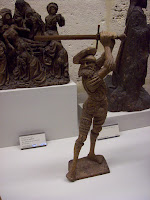 Kelly had class in the morning and meetings in the afternoon, so I was on my own. Managed to not see a single painting. Except a ceiling, but that wasn't an exhibit, that was just part of the palace. There's a section on the Medieval Louvre: it was a castle before it was a palace, and we got to see the foundations of the giant donjon, or tower. Then I looked at sculpture. This was my favourite:
He was amongst pieces of religious art. I also really loved Cupid and Psyche, and another whose name I don't know. A guy resting his head on a girl's shoulder. Very sweet.
Caught lunch with Kelly: paninis I think. Ate in the Parc Monceau, filled with fake ruins and a Lady Liberty. Then borrowed her computer to finish a paper in a Parisian café: both necessary and part of the experience. Finished, and started wandering down the streets, into a couple of magnificent churches: St Augustine and La Madeleine. For dinner we went to Le Marais, the old Jewish quarter, where the best falafel in Paris is to be got. It was damn good. We got a bit turned around, but it was fun exploring! Getting comfortably lost is the best way to see a city, I think.
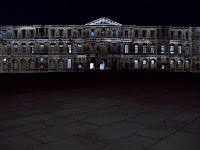 We then walked to the Louvre, to see it lit at night. Beautiful, and a guy was singing Carmen completely wonderfully. It really fit the place. Tried to record it, but came out terribly.
Finished the day looking at wonderfully garish Christmas window displays in expensive department stores.
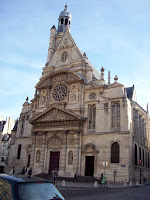 Friday I started the day be getting off the Metro right into a street market. There was a poissonaire, a should have taken a picture of the sign. (It actually means fishmonger.) Walked through the Jardin de Luxembourg, then tried the Panthéon; they wouldn't let us in free because we weren't EU nationals. Bugger on them. Next we checked out Saint-Étienne-du-Mont, which turned out to be my favourite church I've seen here. White, and bright, and simple but complex. Beautiful.
We wandered on to rue Mouftard, a street famous for having street stalls selling cheese and wine and bread and fruit and just about everything. We stocked up for a picnic: bread, cheese, fruit, and Orangina (a French soda), then over to Montmartre. Walked along the sex shops for a couple blocks, it was funny. Then climbed climbed climbed. Very touristy, in a tasteful way, Montmartre, is. Quite lovely. There was a guy singing and playing guitar in the steps of Sacre Cœur, the church at the top. He was good, and there was an audience, so we joined and had our picnic, taking in the view over the city.
Headed down, went to Arc de Triomphe, looked at it, then went down the Champs Élysée to Tuilleries. Champs Élysée is not actually exciting at all; we knew that, it happened to be the direction we were going. Good for people watching. Then walked along the Seine, spitting grape seeds and waving at the boats full of other tourists. And looked at the amazing houseboats lining the river. Reached the Tour Eiffel, touched it, then sat on the Champs de Mars to finish our food. Walked around some more, went to one of the canals, got crêpes for dinner, then to the Ile Saint-Louis, one of the oldest parts of the city. It was rather awesome. Then crossed to Ile de la Cité, seeing swans in the Seine. Walked around Notre Dame, and Pont Neuf, then back to my host's.
We told him our plan for tomorrow was to do the sewer tour, and that we wanted to do the catacombs but they had closed in early September, because of vandalism. Vincent then tells us about the catacombs of Paris; he starts by pulling out from the mess on his table a book of maps, engineer's maps (he's an engineer), that show all the tunnels underneath Paris. The catacombs are actually old quarries that snake under the entire city. When the plague came they were a useful place to pile bodies. Only a small section of them were filled: the 'official' section. The unofficial section has been closed to the public for ages, but there are entrances all over the city, and you can go in if you know where one is. For years, there has been a battle between the guards of the official part and people who roamed the unofficial parts, trying to break in to the official part. It early September the unofficials won: a guy broke through a wall, and with a pick-ax, laid waste to the remains. He basically destroyed the place. It is going to be a long time before the catacombs open again.
We met Saturday morning at Vincent's, took in the view from his building, 14 stories up. Then ventured to a Roman arena, in surprisingly good condition. From there we hopped to le Jardin des Plantes,the Botanical Garden. There was a zoo next door, and we could see the Wallabies! Wandering to Saint-Michel we went through an antiques market, stalls on the street, and poked around. Just about everything was very expensive, but fun to look at. We met up with Kelly's English friend Katie at Saint-Michel, got good, cheap, crêpes, then headed for the sewer entrance.
The sewers were not that exciting. They smalled bad, and looked modern, rather than the old and creepy and awesome I was expecting. The history was interesting, but not worth doing the tour for.
After that we went to visit Saint Eustache, the girls' favourite church in Paris. It was stunning. And there was a choir practicing while we were there. Again the recording sounded awful, but there it was wonderful.
Went to a restaurant, had a mix-up with the wine which meant I drank a half-litre by myself, then ran to the bus station so I wouldn't miss my bus. Going home we flew over London, which was a spectacular sight. Then Sunday I had a terrible bout of culture-shock. It subsided though.
For Kelly's take on things, go here. For the rest of my pictures, try this.
General impressions: Paris was exactly what you think Paris is. Or at least what I thought it was. It was almost a caricature of itself. I seriously heard the Amelie soundtrack all over the city. That said, it was perfectly wonderful.
I went to visit my friend Kelly from Wooster. I have never had a hankering to visit the city, and probably wouldn't have if she weren't there. I also couch-surfed for the first time, and flew Ryanair for the first time. Ryanair is...a bit dodgy, but wonderfully cheap and perfectly fine if you're prepared for it, and I was. Not a bad flight, cloudy but there was an opening just at the French coast. Flew into Beauvais, about an hour bus ride from Paris, and came upon the city. My host lives just a block from the bus station, be we had both not thought to write down directions, so after a detour to Kelly's to use her computer, and getting the key from the highly amusing receptionist, got to my lodging.
It was really wonderful. Tiny flat, but beautiful, great views, very nice area. Vincent wasn't there yet, so we dropped my stuff and went to dinner at a nearby Chinese place. I got the duck. Mmmmm! I went back to the flat, Kelly went back to her place. Vincent had returned. Wonderful guy. Spectacular host. We shared a beer, I slept on a mattress on the floor. Got up early the next morning, and I went to the Louvre.
 Kelly had class in the morning and meetings in the afternoon, so I was on my own. Managed to not see a single painting. Except a ceiling, but that wasn't an exhibit, that was just part of the palace. There's a section on the Medieval Louvre: it was a castle before it was a palace, and we got to see the foundations of the giant donjon, or tower. Then I looked at sculpture. This was my favourite:
He was amongst pieces of religious art. I also really loved Cupid and Psyche, and another whose name I don't know. A guy resting his head on a girl's shoulder. Very sweet.
Caught lunch with Kelly: paninis I think. Ate in the Parc Monceau, filled with fake ruins and a Lady Liberty. Then borrowed her computer to finish a paper in a Parisian café: both necessary and part of the experience. Finished, and started wandering down the streets, into a couple of magnificent churches: St Augustine and La Madeleine. For dinner we went to Le Marais, the old Jewish quarter, where the best falafel in Paris is to be got. It was damn good. We got a bit turned around, but it was fun exploring! Getting comfortably lost is the best way to see a city, I think.
 We then walked to the Louvre, to see it lit at night. Beautiful, and a guy was singing Carmen completely wonderfully. It really fit the place. Tried to record it, but came out terribly.
Finished the day looking at wonderfully garish Christmas window displays in expensive department stores.
 Friday I started the day be getting off the Metro right into a street market. There was a poissonaire, a should have taken a picture of the sign. (It actually means fishmonger.) Walked through the Jardin de Luxembourg, then tried the Panthéon; they wouldn't let us in free because we weren't EU nationals. Bugger on them. Next we checked out Saint-Étienne-du-Mont, which turned out to be my favourite church I've seen here. White, and bright, and simple but complex. Beautiful.
We wandered on to rue Mouftard, a street famous for having street stalls selling cheese and wine and bread and fruit and just about everything. We stocked up for a picnic: bread, cheese, fruit, and Orangina (a French soda), then over to Montmartre. Walked along the sex shops for a couple blocks, it was funny. Then climbed climbed climbed. Very touristy, in a tasteful way, Montmartre, is. Quite lovely. There was a guy singing and playing guitar in the steps of Sacre Cœur, the church at the top. He was good, and there was an audience, so we joined and had our picnic, taking in the view over the city.
Headed down, went to Arc de Triomphe, looked at it, then went down the Champs Élysée to Tuilleries. Champs Élysée is not actually exciting at all; we knew that, it happened to be the direction we were going. Good for people watching. Then walked along the Seine, spitting grape seeds and waving at the boats full of other tourists. And looked at the amazing houseboats lining the river. Reached the Tour Eiffel, touched it, then sat on the Champs de Mars to finish our food. Walked around some more, went to one of the canals, got crêpes for dinner, then to the Ile Saint-Louis, one of the oldest parts of the city. It was rather awesome. Then crossed to Ile de la Cité, seeing swans in the Seine. Walked around Notre Dame, and Pont Neuf, then back to my host's.
We told him our plan for tomorrow was to do the sewer tour, and that we wanted to do the catacombs but they had closed in early September, because of vandalism. Vincent then tells us about the catacombs of Paris; he starts by pulling out from the mess on his table a book of maps, engineer's maps (he's an engineer), that show all the tunnels underneath Paris. The catacombs are actually old quarries that snake under the entire city. When the plague came they were a useful place to pile bodies. Only a small section of them were filled: the 'official' section. The unofficial section has been closed to the public for ages, but there are entrances all over the city, and you can go in if you know where one is. For years, there has been a battle between the guards of the official part and people who roamed the unofficial parts, trying to break in to the official part. It early September the unofficials won: a guy broke through a wall, and with a pick-ax, laid waste to the remains. He basically destroyed the place. It is going to be a long time before the catacombs open again.
We met Saturday morning at Vincent's, took in the view from his building, 14 stories up. Then ventured to a Roman arena, in surprisingly good condition. From there we hopped to le Jardin des Plantes,the Botanical Garden. There was a zoo next door, and we could see the Wallabies! Wandering to Saint-Michel we went through an antiques market, stalls on the street, and poked around. Just about everything was very expensive, but fun to look at. We met up with Kelly's English friend Katie at Saint-Michel, got good, cheap, crêpes, then headed for the sewer entrance.
The sewers were not that exciting. They smalled bad, and looked modern, rather than the old and creepy and awesome I was expecting. The history was interesting, but not worth doing the tour for.
After that we went to visit Saint Eustache, the girls' favourite church in Paris. It was stunning. And there was a choir practicing while we were there. Again the recording sounded awful, but there it was wonderful.
Went to a restaurant, had a mix-up with the wine which meant I drank a half-litre by myself, then ran to the bus station so I wouldn't miss my bus. Going home we flew over London, which was a spectacular sight. Then Sunday I had a terrible bout of culture-shock. It subsided though.
For Kelly's take on things, go here. For the rest of my pictures, try this.
Tuesday, 17 November 2009
Firbush Day Two
Sunday, again we rose early, had a wonderful and large Scottish breakfast, made and packed our lunches, and went for the day's briefing.
Sunday was a different format from Saturday, with a morning and afternoon activity that we were allowed to choose: canoeing, kayaking, road biking, mountain biking, orienteering, and going for a walk. For the morning I chose mountain biking, along with three other people.
None of us had ever done real mountain biking before; I had been on rough steep roads, but never trails. So we were given a crash course in the correct use of gears and breaks, correct stance, and a quick trial run on the grounds. We had a choice of going up and down a mountain, or along a series of trails that led to the castle and the town of Killin. We chose the latter, for reasons of both difficulty and getting to see the castle.
Quite fun, quite terrifying at times - free-wheeling down a steep, narrow, muddy path. on the way we passed a circle of standing stones - ancient Celtic religious sites.
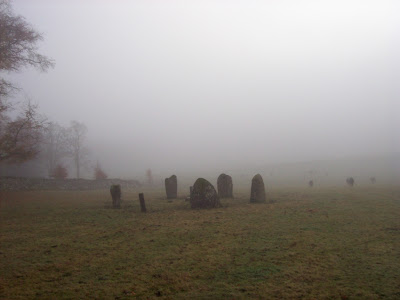
These particular ones were unusual because they were in a complete double circle. Some of them were also covered in garnets.
Got back on the bikes and reached the castle. It was rather awesome.
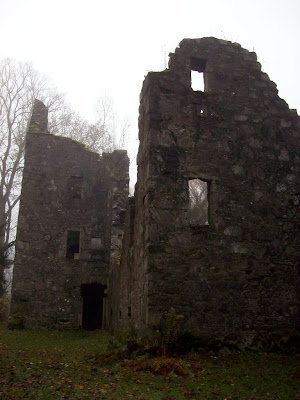
They almost held Parliament here once. Edinburgh was too close to England, so they called it here, but it was so far away from everywhere that no one showed. I looked for swords. No dice.
Took a route though the town, Killin. It was nice, picturesque. Spent some time at the Falls of Dochart, in the centre of town. Arrived back at the lodge with plenty of time for a relaxing lunch.
We decided to kayak in the afternoon. Our legs had been vigorously exercised over the preceding days, but not our upper bodies, plus the people who had kayaked in the morning said it was wonderful.
We geared up in wetsuits and waterproofs, and entered the harbour. Spent about 20 minutes learning the ins and outs of kayak manoeuvring, and getting used to the crafts, then headed south. It was a huge struggle for me. it seemed like everyone else was gliding through the water with the greatest of ease; I couldn't keep my boat straight, each stroke hurt my muscles. My feet didn't exactly fit nicely inside the narrow kayak, especially in the huge old pair of shoes I was wearing. At one point I almost got a charlie-horse. Still though, saw some fantastic scenery, those few times with the clouds lifted a bit.
Back at the lodge, after returning all the equipment and resting my arms a bit, we had a tea.
Now at this point, I should explain how confusing the word "tea" is in Britain. It means dinner. If someone invites you for tea, or asks you to stay for tea, don't eat beforehand. But there is also the afternoon tea, which is what we in the States normally thing of: a snack with tea and cakes and jam, and maybe sandwiches. Which is the kind we had at Firbush.
It was delicious. Scones (rhymes with 'on'), coffee, tea, toast, jam, biscuits...I was right full after.
Then the mini drove us the hour to Stirling, where we Glaswegians (except Mike) just managed to catch a train about a minute before it left. Don't worry though, trains run often. He wouldn't have had to wait too long.
You can view the whole album here.
Sunday was a different format from Saturday, with a morning and afternoon activity that we were allowed to choose: canoeing, kayaking, road biking, mountain biking, orienteering, and going for a walk. For the morning I chose mountain biking, along with three other people.
None of us had ever done real mountain biking before; I had been on rough steep roads, but never trails. So we were given a crash course in the correct use of gears and breaks, correct stance, and a quick trial run on the grounds. We had a choice of going up and down a mountain, or along a series of trails that led to the castle and the town of Killin. We chose the latter, for reasons of both difficulty and getting to see the castle.
Quite fun, quite terrifying at times - free-wheeling down a steep, narrow, muddy path. on the way we passed a circle of standing stones - ancient Celtic religious sites.

These particular ones were unusual because they were in a complete double circle. Some of them were also covered in garnets.
Got back on the bikes and reached the castle. It was rather awesome.

They almost held Parliament here once. Edinburgh was too close to England, so they called it here, but it was so far away from everywhere that no one showed. I looked for swords. No dice.
Took a route though the town, Killin. It was nice, picturesque. Spent some time at the Falls of Dochart, in the centre of town. Arrived back at the lodge with plenty of time for a relaxing lunch.
We decided to kayak in the afternoon. Our legs had been vigorously exercised over the preceding days, but not our upper bodies, plus the people who had kayaked in the morning said it was wonderful.
We geared up in wetsuits and waterproofs, and entered the harbour. Spent about 20 minutes learning the ins and outs of kayak manoeuvring, and getting used to the crafts, then headed south. It was a huge struggle for me. it seemed like everyone else was gliding through the water with the greatest of ease; I couldn't keep my boat straight, each stroke hurt my muscles. My feet didn't exactly fit nicely inside the narrow kayak, especially in the huge old pair of shoes I was wearing. At one point I almost got a charlie-horse. Still though, saw some fantastic scenery, those few times with the clouds lifted a bit.
Back at the lodge, after returning all the equipment and resting my arms a bit, we had a tea.
Now at this point, I should explain how confusing the word "tea" is in Britain. It means dinner. If someone invites you for tea, or asks you to stay for tea, don't eat beforehand. But there is also the afternoon tea, which is what we in the States normally thing of: a snack with tea and cakes and jam, and maybe sandwiches. Which is the kind we had at Firbush.
It was delicious. Scones (rhymes with 'on'), coffee, tea, toast, jam, biscuits...I was right full after.
Then the mini drove us the hour to Stirling, where we Glaswegians (except Mike) just managed to catch a train about a minute before it left. Don't worry though, trains run often. He wouldn't have had to wait too long.
You can view the whole album here.
Monday, 16 November 2009
I am the Drummer
I am the Drummer
I make my own beat
With its own sort of rhythm
As I march down the street.
And I am the Marcher,
I walk my own street.
Its name is my name;
Its sound is my beat.
I am the Drummer,
I create my own beat:
Sometimes slow and muddled,
Sometimes quick and neat.
Sometimes with one hand,
Sometimes with three,
And sometimes it's more like
The drum's playing me.
I am the Marcher,
This is my street:
It's got cafés on side-walks
Where cool people eat.
It merges and junctions
With other streets often,
Their own drummers drumming,
Some soft and some rockin'.
But I am the Drummer
On the street that I'm strolling,
And marching and dancing,
Running, patrolling.
Sometimes I'm also
The emcee and the band,
And sometimes it's just me,
My drum, and my hand.
Those times when my marching
And drumming don't match,
Mains break and gas leaks
And sewers collapse.
Potholes and black ice,
Frost heaves and wash-outs.
But my road continues
So long as my drum shouts.
I am the Marcher;
This is my street.
I make my own route,
And I plant my own feet.
The scenery varies:
City, shore, town,
Sometimes there's none,
Not even barren ground.
No street is forever,
The drum ceases, my friend.
The Marcher stops marching
When he hits a dead end.
But my beat echoes on,
Through alleys and closes
And tells other Drummers
What an ill rhythmed, sweet beated, foot stompin', hard rockin', hard mockin', throw-your-head-back-and-cheer-in-the-streets shockin' life lived at the tip of your nose is!
I make my own beat
With its own sort of rhythm
As I march down the street.
And I am the Marcher,
I walk my own street.
Its name is my name;
Its sound is my beat.
I am the Drummer,
I create my own beat:
Sometimes slow and muddled,
Sometimes quick and neat.
Sometimes with one hand,
Sometimes with three,
And sometimes it's more like
The drum's playing me.
I am the Marcher,
This is my street:
It's got cafés on side-walks
Where cool people eat.
It merges and junctions
With other streets often,
Their own drummers drumming,
Some soft and some rockin'.
But I am the Drummer
On the street that I'm strolling,
And marching and dancing,
Running, patrolling.
Sometimes I'm also
The emcee and the band,
And sometimes it's just me,
My drum, and my hand.
Those times when my marching
And drumming don't match,
Mains break and gas leaks
And sewers collapse.
Potholes and black ice,
Frost heaves and wash-outs.
But my road continues
So long as my drum shouts.
I am the Marcher;
This is my street.
I make my own route,
And I plant my own feet.
The scenery varies:
City, shore, town,
Sometimes there's none,
Not even barren ground.
No street is forever,
The drum ceases, my friend.
The Marcher stops marching
When he hits a dead end.
But my beat echoes on,
Through alleys and closes
And tells other Drummers
What an ill rhythmed, sweet beated, foot stompin', hard rockin', hard mockin', throw-your-head-back-and-cheer-in-the-streets shockin' life lived at the tip of your nose is!
Sunday, 15 November 2009
Firbush Day One
Sorry about the delay in posts: I've been busy. Trips and papers.
So, last weekend I went on an Arcadia sponsored trip to Firbush Point at Loch Tay in the Southern Highlands. Firbush is a centre run by Uni. Edinburgh with bunks, a dining room, a bar, and all the equipment you would ever need. They also supplied delicious homemade food. We arrived Friday evening (Day Zero), were fed an excellent traditional Scottish dinner of fish and chips with brown sauce or salt and vinegar, and mushy peas. Hung out at the bar, socialised, got to know each other.
Saturday morning we woke up early, around eight or half eight. Were fed another wonderful meal: a full Scottish breakfast - eggs, bacon, pork sausage, square sausage, roasted tomatoes, porridge, tea, coffee, and toast. We made and packed our lunches for the day's sojourn, packed our bags with what we thought we'd need on the mountain, and went to the briefing. We were going to be hill-walking Monros that day, and needed to be prepared.
A Monro is any Scottish mountain over 3000 feet high, named after the man who surveyed them. While not especially tall by mountaineering standards, they pose a challenge due to their high latitude, wind exposure, exposure to Atlantic weather systems, and craggy, difficult terrain.
The weather was a crap-shoot. There was a wedge of clouds over Scotland, with the tops of our Monros just at the very edge.
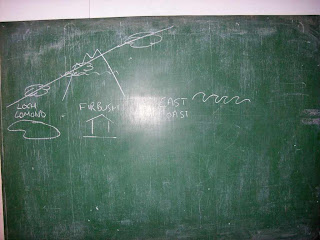
There would be no way of knowing if we would have views until we summited, but we did the the wind would be minimal: 10 to 15 mph. Our guides told us the procedure for getting boots, fleeces, packs, water-bottles, hats, gloves, wind- and water-proof coats and trousers, hot-drink flasks, and anything else we might need. I needed only the waterproof clothing and gloves, and decided to take a flask. My boots and hat are pretty amazing.
Everyone get set and we drove to the base of our first task: Beinn Ghlas, 3620 feet. We couldn't see the peak from the base; it looked as if we were about to walk a small hill. Nope. Every time (except the last) we got to what looked like it would be the top, there was another peak ahead. It was a nice hill walk, slightly challenging, especially at the speed we were going, but absolutely doable. We entered the cloud about half way up, and the mist over everything made for an interesting ambiance.
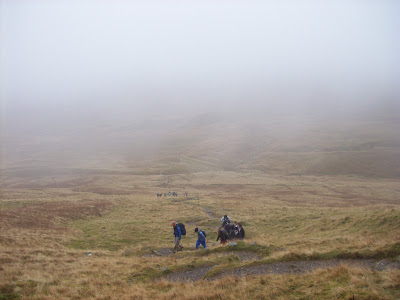
Nearer to the top the temperature dropped to zero, and the landscape was covered in rime ice. It was beautiful. The coolness felt nice because we were all so warm from our walking.
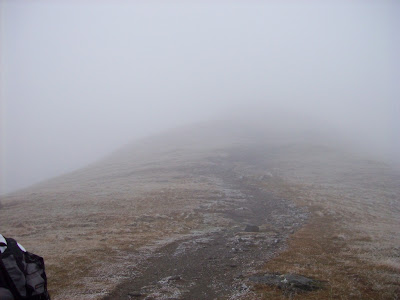
We reached the summit! WooHoo!
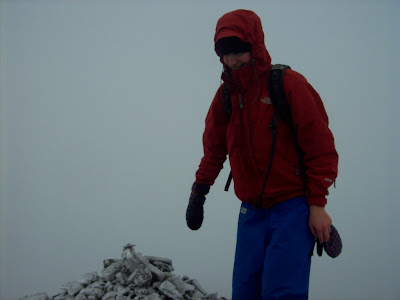
By this time there was actual snow on the ground, not just rime ice, and our instructors had us all don our waterproofs. That's a cairn, a monument, usually a pile of stones, on Scottish summits.
We didn't spend too much time there, and began to descend the other side. This time the path was on the top of a very narrow ridge with very steep sides. We stopped for lunch when we reach the dip between the two Monros, on a wide snow-covered field, still quite high. Lunch was good, as was my hot chocolate.
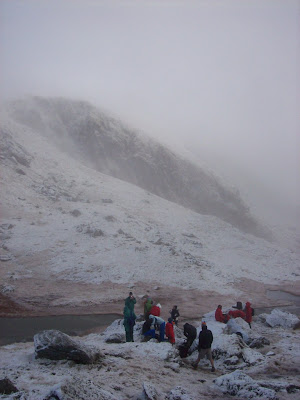
Then the cloud started to lift! The views were simply fantastic, like nothing I had ever seen. I couldn't believe I was looking at them with my own eyes. My camera, much as I love it, could not come close to capturing it. I tried though.
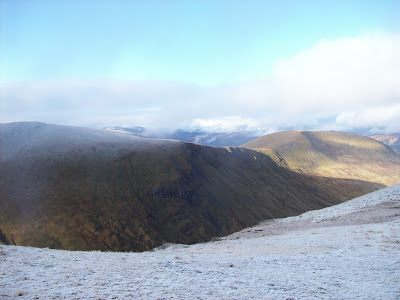
The group split at this point: those who would continue to the next Monro and those who would return to Firbush right then. Some people were having trouble, one girl in particular was getting a wee bit sick from the altitude and exertion. I was feeling tip-top, and of course chose the first group. We were told it would be about an hour's journey all together, up and back.
The second peak was Ben Lawers, 3984 feet. At one point a group of people built a 17-foot mound and tower on the top to bring it to 4000 feet, but these have since eroded away, and anyway wouldn't count in mountain-measuring. The ascent of Ben Lawers looked to be much more difficult.
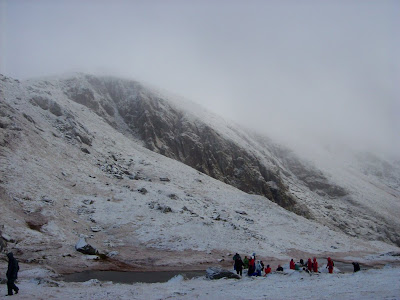
And it was. It was steep, and slick, and completely amazing. We spent a long while relaxing at the top.
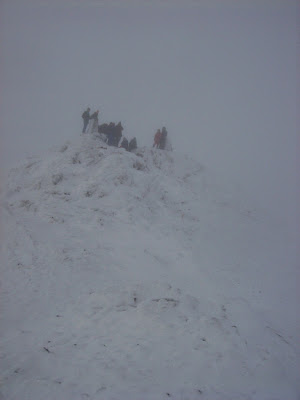
The cloud gave it this feeling that if we stepped of the edge we'd fall forever into the void - there was no bottom.
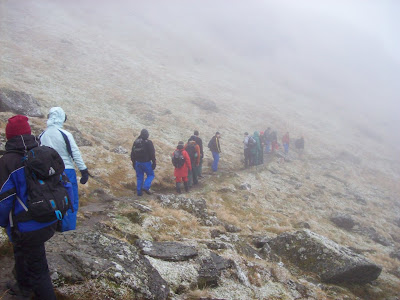
But it got cold after so much time not moving very much, so we headed down, sliding on our butts and boots, throwing snowballs. We reached the lunch spot quickly, having spent less than an hour in total on Ben Lawers.
The journey back to the base seemed to take forever. We used a different route, around the side of Beinn Ghlas. Our guide pointed out different interesting things, such as the remains of a Bronze-Age settlement, and how the National Trust for Scotland, who now own most of the mountain, puts small mounds next the path that subconsciously keep people on the path. Legally you're allowed to walk and camp almost anywhere in the whole of Scotland, but to keep erosion to a minimum, especially on popular peaks like Lawers and Ghlas, they like you to stick to the paths.
We had a traditional Rabbie Burns supper that night: split pea soup, then chicken stuffed with haggis, and something delicious though I can't remember what for dessert. Haggis is pretty damn good! Glad I finally tried it!
Then we cleared the tables and chairs, washed up, and were piped back to the dining room for a Ceilidh. This was after spending the day climbing Monros. Ow. But I danced every dance, and didn't want it to stop. I realize though, I'm growing tired of Ceilidhs. They're fun, but the same dances are danced at every one, just about. One or two might change. And they don't have the challenge that I'm used to with complex contradancing.
For the last part of the Ceilidh the piper talked about the traditions of piping. The thing I remember most is about Classical Scottish Music. I can't remember the word for it, but basically there is a giant repertoire of piping pieces that are not tunes, but meant to evoke certain seasons, or battles, or activities. They last for twenty to fifty minutes, are not hummable, and often basically tuneless. It's about the sound. Our piper discovered them too late in life to know any, and I'm glad he didn't play any, because indoors is not the place for an extended period of pipes.
Some of us stayed up late chatting, knowing full well we had to get up early the next morning again. Oh well.
Take a look at all my pictures here.
Day Two will be posted later.
So, last weekend I went on an Arcadia sponsored trip to Firbush Point at Loch Tay in the Southern Highlands. Firbush is a centre run by Uni. Edinburgh with bunks, a dining room, a bar, and all the equipment you would ever need. They also supplied delicious homemade food. We arrived Friday evening (Day Zero), were fed an excellent traditional Scottish dinner of fish and chips with brown sauce or salt and vinegar, and mushy peas. Hung out at the bar, socialised, got to know each other.
Saturday morning we woke up early, around eight or half eight. Were fed another wonderful meal: a full Scottish breakfast - eggs, bacon, pork sausage, square sausage, roasted tomatoes, porridge, tea, coffee, and toast. We made and packed our lunches for the day's sojourn, packed our bags with what we thought we'd need on the mountain, and went to the briefing. We were going to be hill-walking Monros that day, and needed to be prepared.
A Monro is any Scottish mountain over 3000 feet high, named after the man who surveyed them. While not especially tall by mountaineering standards, they pose a challenge due to their high latitude, wind exposure, exposure to Atlantic weather systems, and craggy, difficult terrain.
The weather was a crap-shoot. There was a wedge of clouds over Scotland, with the tops of our Monros just at the very edge.

There would be no way of knowing if we would have views until we summited, but we did the the wind would be minimal: 10 to 15 mph. Our guides told us the procedure for getting boots, fleeces, packs, water-bottles, hats, gloves, wind- and water-proof coats and trousers, hot-drink flasks, and anything else we might need. I needed only the waterproof clothing and gloves, and decided to take a flask. My boots and hat are pretty amazing.
Everyone get set and we drove to the base of our first task: Beinn Ghlas, 3620 feet. We couldn't see the peak from the base; it looked as if we were about to walk a small hill. Nope. Every time (except the last) we got to what looked like it would be the top, there was another peak ahead. It was a nice hill walk, slightly challenging, especially at the speed we were going, but absolutely doable. We entered the cloud about half way up, and the mist over everything made for an interesting ambiance.

Nearer to the top the temperature dropped to zero, and the landscape was covered in rime ice. It was beautiful. The coolness felt nice because we were all so warm from our walking.

We reached the summit! WooHoo!

By this time there was actual snow on the ground, not just rime ice, and our instructors had us all don our waterproofs. That's a cairn, a monument, usually a pile of stones, on Scottish summits.
We didn't spend too much time there, and began to descend the other side. This time the path was on the top of a very narrow ridge with very steep sides. We stopped for lunch when we reach the dip between the two Monros, on a wide snow-covered field, still quite high. Lunch was good, as was my hot chocolate.

Then the cloud started to lift! The views were simply fantastic, like nothing I had ever seen. I couldn't believe I was looking at them with my own eyes. My camera, much as I love it, could not come close to capturing it. I tried though.

The group split at this point: those who would continue to the next Monro and those who would return to Firbush right then. Some people were having trouble, one girl in particular was getting a wee bit sick from the altitude and exertion. I was feeling tip-top, and of course chose the first group. We were told it would be about an hour's journey all together, up and back.
The second peak was Ben Lawers, 3984 feet. At one point a group of people built a 17-foot mound and tower on the top to bring it to 4000 feet, but these have since eroded away, and anyway wouldn't count in mountain-measuring. The ascent of Ben Lawers looked to be much more difficult.

And it was. It was steep, and slick, and completely amazing. We spent a long while relaxing at the top.

The cloud gave it this feeling that if we stepped of the edge we'd fall forever into the void - there was no bottom.
But it got cold after so much time not moving very much, so we headed down, sliding on our butts and boots, throwing snowballs. We reached the lunch spot quickly, having spent less than an hour in total on Ben Lawers.
The journey back to the base seemed to take forever. We used a different route, around the side of Beinn Ghlas. Our guide pointed out different interesting things, such as the remains of a Bronze-Age settlement, and how the National Trust for Scotland, who now own most of the mountain, puts small mounds next the path that subconsciously keep people on the path. Legally you're allowed to walk and camp almost anywhere in the whole of Scotland, but to keep erosion to a minimum, especially on popular peaks like Lawers and Ghlas, they like you to stick to the paths.

We had a traditional Rabbie Burns supper that night: split pea soup, then chicken stuffed with haggis, and something delicious though I can't remember what for dessert. Haggis is pretty damn good! Glad I finally tried it!
Then we cleared the tables and chairs, washed up, and were piped back to the dining room for a Ceilidh. This was after spending the day climbing Monros. Ow. But I danced every dance, and didn't want it to stop. I realize though, I'm growing tired of Ceilidhs. They're fun, but the same dances are danced at every one, just about. One or two might change. And they don't have the challenge that I'm used to with complex contradancing.
For the last part of the Ceilidh the piper talked about the traditions of piping. The thing I remember most is about Classical Scottish Music. I can't remember the word for it, but basically there is a giant repertoire of piping pieces that are not tunes, but meant to evoke certain seasons, or battles, or activities. They last for twenty to fifty minutes, are not hummable, and often basically tuneless. It's about the sound. Our piper discovered them too late in life to know any, and I'm glad he didn't play any, because indoors is not the place for an extended period of pipes.
Some of us stayed up late chatting, knowing full well we had to get up early the next morning again. Oh well.
Take a look at all my pictures here.
Day Two will be posted later.
Wednesday, 11 November 2009
Some Pictures
Some pictures have just been posted. They're pretty spectacular.
http://picasaweb.google.com/tyrannophobe
http://picasaweb.google.com/tyrannophobe
Monday, 9 November 2009
Halloween and Guy Fawkes
How do the Scots do Halloween? Basically the same as Americans, just not as much. It is originally Celtic, after all. The year started and ended right around now, and just as the barrier between the year was being broken, other barriers, including between this world and the other world, were too. So you dressed in your neighbors clothes to disguise yourself from the evil spirits and witches and pixies and brownies and whatnot, and carved turnips into scary faced lanterns to protect your house. This was exported to Canada and eventually the US, Trick-or-Treating developed, and it was re-imported into Scotland, under the name 'guising.' (Though people more and more talk about Trick-or-Treating.)
Those who are too old to do that also celebrate the same way in Scotland as in the US - fancy dress (i.e. costume) parties! I went as an English Imperialist.

The only spectacular costumes I saw were Sweeny Todd and Mrs. Lovett, very well done.
Then the 5th of November, Guy Fawkes Day / Bonfire Night. Traditionally it's bigger than Halloween; Halloween is when children used to make effigies for Bonfire Night. The story is that Queen Elizabeth I died, with no heir, so through the laws of succession King James VI of Scotland became James I of England as well. James was Protestant (as was Elizabeth and legally England), so a militant Catholic named Guy Fawkes, who had some really awesome facial hair, tried to blow up Parliament on November 5th - the Gunpowder Plot. He was foiled, and the British ever since have celebrated his failure by burning him in effigy, lighting bonfires, and shooting off tons of fireworks.
The official celebration was on the Glasgow Green, a large city park, basically a lawn. It seemed like the whole city was there. There were carnival rides and music, then there was an excellent fireworks show, then everyone left, most headed to the bars and pubs. Good stuff.
A report on my Highland Adventure is coming soon, and I'm off to Paris this week, so an account of that will come shortly as well!
Those who are too old to do that also celebrate the same way in Scotland as in the US - fancy dress (i.e. costume) parties! I went as an English Imperialist.

The only spectacular costumes I saw were Sweeny Todd and Mrs. Lovett, very well done.
Then the 5th of November, Guy Fawkes Day / Bonfire Night. Traditionally it's bigger than Halloween; Halloween is when children used to make effigies for Bonfire Night. The story is that Queen Elizabeth I died, with no heir, so through the laws of succession King James VI of Scotland became James I of England as well. James was Protestant (as was Elizabeth and legally England), so a militant Catholic named Guy Fawkes, who had some really awesome facial hair, tried to blow up Parliament on November 5th - the Gunpowder Plot. He was foiled, and the British ever since have celebrated his failure by burning him in effigy, lighting bonfires, and shooting off tons of fireworks.
The official celebration was on the Glasgow Green, a large city park, basically a lawn. It seemed like the whole city was there. There were carnival rides and music, then there was an excellent fireworks show, then everyone left, most headed to the bars and pubs. Good stuff.
A report on my Highland Adventure is coming soon, and I'm off to Paris this week, so an account of that will come shortly as well!
Wednesday, 4 November 2009
Lost in Translation
The Uni sent me this email:
I have to laugh every time I read it.
The University Rector, Charles Kennedy, will be holding a surgery on Friday 13th November 2009, from 4-5pm, in the SRC Advice Centre, Ground floor, John McIntyre Building.
Please come along and raise any issues with Charles who will be able to take these on at a University or national level.
The surgery is a drop-in session so no appointment is necessary.
Further dates will be advertised throughout the year.
I have to laugh every time I read it.
Subscribe to:
Posts (Atom)